Home | Jessica Giddens DNP, BA, APRN, PMHNP-BC, RN-BC |

Healthcare Provider, Professor

  • Publications
  • Webcasts
  • Podcast
  • Radio
  • Bio
  • Presentations
  • CV / Resume
  • Summary of Kaul, et al. KarXT EMERGENT-2

    Title of the Reference Article:

    Efficacy and safety of the muscarinic receptor agonist KarXT (xanomeline–trospium) in schizophrenia (EMERGENT-2) in the USA: results from a randomised, double-blind, placebo-controlled, flexible-dose phase 3 trial

    Article DOI:

    https://doi.org/10.1016/S0140-6736(23)02190-6

    Citation: 1. Kaul I, Sawchak S, Correll CU, et al. Group Kaul I, Sawchak S, Correll CU, et al. Efficacy and Safety of the Muscarinic Receptor Agonist Karxt (Xanomeline–Trospium) in Schizophrenia (Emergent-2) in the USA: Results from a Randomised, Double-Blind, Placebo-Controlled, Flexible-Dose Phase 3 Trial. 2024;403(10422):160-170.

    https://www.thelancet.com/journals/lancet/article/PIIS0140-6736(23)02190-6/abstract

    . Accessed August 22, 2024.

    Authors of the Article:

    • Inder Kaul, MD
    • Sharon Sawchak, RN
    • Prof Christoph U Correll, MD
    • Rishi Kakar, MD
    • Prof Alan Breier, MD
    • Haiyuan Zhu, PhD
    • Andrew C Miller, PhD
    • Steven M Paul, MD
    • Stephen K Brannan, MD

    Summary:

    The article summarizes the results of the EMERGENT-2 trial, which investigated the efficacy and safety of KarXT, a novel treatment for schizophrenia. KarXT combines xanomeline, a muscarinic receptor agonist, with trospium chloride, which is designed to reduce xanomeline-related side effects. Unlike traditional antipsychotics that block D2 dopamine receptors, KarXT targets muscarinic receptors.

    Background:

    • There is a critical need for new treatments for schizophrenia that operate through different mechanisms than current D2 dopamine receptor blockers. Xanomeline, a muscarinic receptor agonist, combined with trospium chloride (KarXT), aims to reduce the side effects associated with peripheral muscarinic receptor activation.

    Methods:

    • EMERGENT-2 was a 5-week, phase 3, randomized, double-blind, placebo-controlled trial designed to evaluate KarXT in 252 acutely psychotic schizophrenia patients.
    • Participants: Adults aged 18-65 with schizophrenia, recent psychosis exacerbation, and specific severity scores on the PANSS and CGI-S scales.
    • Intervention: Participants received either KarXT or placebo. KarXT dosing started at 50mg xanomeline/20 mg trospium, increasing to 100 mg xanomeline/20 mg trospium, with an optional increase to 125 mg xanomeline/30 mg trospium based on tolerability.
    • Primary Endpoint: Change in PANSS total score from baseline to week 5

    Findings:

    • Efficacy: KarXT significantly reduced PANSS scores compared to placebo (-21.2 vs. -11.6, p<0.0001), with a Cohen’s d effect size of 0.61. It also met all secondary efficacy endpoints.
    • Safety: Common adverse events for KarXT included constipation, dyspepsia, and nausea. There were no significant differences in extrapyramidal symptoms or akathisia between KarXT and placebo.
    • Tolerability: Despite some gastrointestinal side effects, KarXT was generally well tolerated.

    · Adverse Events: Common side effects with KarXT included constipation, dyspepsia, nausea, and vomiting, but rates of extrapyramidal symptoms, akathisia, weight gain, and somnolence were similar to placebo.

    Interpretation:

    • KarXT showed efficacy in reducing both positive and negative symptoms of schizophrenia and was generally well-tolerated, suggesting it could represent a new class of antipsychotic medication that does not rely on D2 dopamine receptor blockade.

    Funding:

    • The trial was funded by Karuna Therapeutics.

    Notes:

    • Additional trials (EMERGENT-3, EMERGENT-4, and EMERGENT-5) are ongoing to further assess KarXT’s efficacy and safety.

    *AI was utilized for this summary.

    Share this:

    • Share on X (Opens in new window) X
    • Share on Facebook (Opens in new window) Facebook
    • Share on LinkedIn (Opens in new window) LinkedIn
    • Share on Tumblr (Opens in new window) Tumblr
    • Share on Pinterest (Opens in new window) Pinterest
    • Print (Opens in new window) Print
    • Email a link to a friend (Opens in new window) Email
    Like Loading…
  • “The Ick” Social Media and Personality Psychopathology Continued

    So I thought I would write another post about social media and psychopathology that was inspired by reading this article: https://www.psychologytoday.com/us/blog/social-instincts/202408/2-ways-that-the-ick-can-ruin-a-perfectly-good-relationship

    I have talked about how there is research that has shown that social media use is amplifying especially more negative behavioral traits. Here is one on narcissism. To individuals susceptible to borderline personality disorder, histrionic personality disorder, addiction, and narcissism to name a few, the use of social media continues to reinforce these neural pathways. It amplifies trauma and addiction pathways as well. I saw it in my practice and continue to see it in the community. In today’s world someone may claim it gives them “the ick”.

    So what is so harmful about “the ick”. It is another example of the amplification of negative behavioral traits. While some people may be using “the ick” as a social joke or humorous situation, what many don’t realize is that over time even the joke can be adopted unhealthily. The tendency to immediately display emotions, no filter, and acting on snap judgements is a hallmark of significant emotional reactivity – and something that generally in the realm of mental health we start working up to assess for mental health conditions such as ADHD, personality disorders, and other disorders with impulse control symptomatology.

    Like the article discusses “the ick” can cause individuals to be quickly dismissive, aggressive, rude, and superficial in the name of humor. (Which don’t get me wrong I am not anti-humor), but I do like to consider what chronic exposure to “ick” videos does in terms of forming neural pathways that are more accepting of these behaviors over time and the vicarious “learning” that is done. What is also interesting is that in mental health, professionals understand that if appropriate social interactions are not being had during formative years – it leads to specific behavioral traits such as impulsivity, aggression, low self esteem, loneliness, dependence, addiction, and the list goes on. We have a generation of individuals raised by technology and a smart phone. I sometimes talk about this with my students – even if the child is not exposed to technology, a distracted parent who is answering to a device during formative childhood social interactions is training the child’s neural pathways during those bidirectional communication moments and what we are seeing is deficited social communication.

    Like the article mentioned one has to wonder if there are rooted fears driving some of “the ick”. We explore these fears in the office, like fear of commitment and significant relationship insecurity. Furthermore we consider low self-esteem, attempts to avoid loneliness but through means that also attempt to avoid severe rejection sensitivity. I know I saw plenty of these behaviors in my office.

    Interestingly, in my office though many patients would state things like they were “having difficulty socializing” (outside of social media). They “felt like the weird kid” and they expressed difficulties engaging in healthy back and forth relationships. If you are reading between the lines here, it starts to sound like what has also become a trendy sensation which is to be diagnosed with autism spectrum disorder. I can definitely say in my practice I too was believing that perhaps there may be something to this, perhaps there were some missed diagnoses (there are…) but not to the level that we are seeing with individuals seeking a diagnosis after exposure to TikTok and other social media platforms.

    I could go on for quite a while on these subjects, but today, I really just want to focus on the impact chronic social media use is having is having on mental health, the formation of personality (especially in children and adolescents who are still forming these neural pathways), and just drive thoughtful inquiry around the topic. For practitioners, it is going to be more imperative that we be mindful when giving diagnoses and consider the influence of these social factors.

    I very much appreciate science and dialogue. While today’s discussions was not generated based on reading the empiric scientific literature, it is relevant to mental health. Please send me your thoughts, send me your research, or even just questions!

    Share this:

    • Share on X (Opens in new window) X
    • Share on Facebook (Opens in new window) Facebook
    • Share on LinkedIn (Opens in new window) LinkedIn
    • Share on Tumblr (Opens in new window) Tumblr
    • Share on Pinterest (Opens in new window) Pinterest
    • Print (Opens in new window) Print
    • Email a link to a friend (Opens in new window) Email
    Like Loading…
  • Social Media and Personality Psychopathology

    https://www.sciencedirect.com/science/article/pii/S0010440X22000682?via%3Dihub

    So today I wanted to talk about a topic that I think I will hopefully be posting more on in coming days in addition to my autism and other healthcare related posts.

    I really liked this article because it opened up with looking at symptom overlap and the transdiagnostic approach, which is going to be so much more relevant in today’s social media, self-diagnosis practice environment. It is also a reason I am a strong supporter of the RDoC (Research Domain Criteria) framework. https://www.nimh.nih.gov/research/research-funded-by-nimh/rdoc

    The article beyond these concepts however, starts to dabble in THE TOPIC of the day – the impact of social media on mental health. I will tell you my thoughts on this subject are too vast for one post. So I will stick to commenting on the subjects raised in this article. The first being the “sick culture” that is raised by social media platforms. There is some truth to this statement. As a mental health professional, I am 100% in support of more self-awareness, education, and decreasing the stigma of mental illness. We need this, but the article in fact is highlighting a problem that can happen in the social media bubble especially through algorithm amplification with the pervasive spread of misinformation. With that is the spread of emotional information as well.

    Sadly, autism right now is a good example. Before the pandemic really was in full force I was speaking on neurodiversity and autism. The self-diagnosis culture however exploded during the pandemic. It is now popular to identify with this condition or any number of labels. The mental health communities that are forming are alluring to people especially youth. Again, I can’t just rant on it, because when I was in practice I used to tell my patients how much I wish there was a support group specifically for them, a place I could refer them to find other people that were similarly struggling so they wouldn’t feel alone. But, there is a side of #socialmedia that is problematic that wasn’t seen as much in the traditional support group. It is the same problem that has brought about the “tide pod” ingestion craze, the gorging until you vomit online, the freezing off toes and damaging one’s body all for the “like/shares”. This is NOT a healthy expression or echo chamber in many cases for mental health conditions. It has also brought about the concept of “sad fishing” or trying to get like/shares by posting about how hard things are.

    The article points out one very important concept that is in need of research, and that is the adoption of peri-psychiatric or self-diagnosed conditions and then furthermore adopting a persona that the community has actually created. I do think there are people that are more significantly impacted by this and we need more research. I have posted on social media platforms and linked articles about increased personality traits such as narcissism, borderline personality, and histrionic personality traits that are exacerbated by the algorithms and addictive like/share environment. I encourage everyone to read more on these concepts, especially while thinking closely about children, adolescents, developmental milestones, Erik Erikson, and other concepts. I also welcome any discussion on this topic! Send my your science 😀

    Share this:

    • Share on X (Opens in new window) X
    • Share on Facebook (Opens in new window) Facebook
    • Share on LinkedIn (Opens in new window) LinkedIn
    • Share on Tumblr (Opens in new window) Tumblr
    • Share on Pinterest (Opens in new window) Pinterest
    • Print (Opens in new window) Print
    • Email a link to a friend (Opens in new window) Email
    Like Loading…
  • Social Media ADHD AuDHD Autism???

    I think this article gives a very good viewpoint, especially in light of this whole #socialmedia #digitalmedia #internet driven #selfdiagnosis of #autism #asd #AuDHD. https://www.ncbi.nlm.nih.gov/pmc/articles/PMC7366944/ In reality, it more likely technology overuse induced deficits in cognitive dysfunction, including decreased working memory, decreased executive function, decreased task-switching ability, and decreased cognitive empathy. There are other studies that demonstrate increased personality disorder traits, including histrionic, narcissistic, #borderline #BPD, and avoidant, as well as the increased use of social media. I think anecdotally, as clinicians, we have seen the rise of these mental health-related issues in practice and the sequel, including suicidality, more neurosis, more loneliness, and more dysphoria, to name a few.

    We will have to do a better job moving forward diagnostically and helping our patients navigate this space. Especially with all the disinformation and misinformation being spread on social media platforms through the neurodiversity movement on all mental health conditions but especially autism, ADHD, and popular ones being discussed under the #neurodiversity hashtags. In the autism space I am especially concerned as there is an uptick in what people describe as #PDA (pathological demand avoidance), #meltdowns, #sensoryoverload, #selfharm, and #suicidality which historically was more frequently seen in the personality disorders (which yes do require a decrease in #stigmatization) as there are other studies that support that mental health professionals report having less empathy with individuals with personality disorders, specifically borderline personality disorder.

    Anecdotally, I believe that we all have also all see the increase in internet addiction and withdrawal like symptoms when individuals are denied access to technology. We have heard more and more in our offices as parents describe a child that has epic meltdowns when the technology is taken away and it is “the only thing that calms them down”. Now it is more being considered as a “possible sign of autism”. I think diagnostically we need to consider the potential for the negative effects that technology is having on the brain and a symptom profile that is emerging from long term and excessive technology use in sensitive individuals. We need to find better measures to identify this symptom profile with effective therapy strategies that may be similar or different from therapies that are used for autism spectrum disorder, but remember that services are still lacking significantly for individuals who are autistic.

    I also think anecdotally we have seen an uptick in the educational autism diagnosis for an IEP. I am actually in support of schools doing everything they can to improve social emotional interventions because the technology usage is CLEARLY changing the way individuals brains are growing and developing. At some point I would like to do a discussion on Erik Erikson and developmental stages, but I will have to leave that to another post.

    Again, I very much welcome any dialogue related to this post. I also recognize that many individuals that have found the self-diagnosis of autism to be something they identify with to comment and discuss.

    Here are references that have informed this article and images were linked to their source pages sorry it is not in APA or AMA style:

    Reference: Sanzari CM, Gorrell S, Anderson LM, Reilly EE, Niemiec MA, Orloff NC, Anderson DA, Hormes JM. The impact of social media use on body image and disordered eating behaviors: Content matters more than duration of exposure. Eat Behav. 2023 Apr;49:101722. doi: 10.1016/j.eatbeh.2023.101722. Epub 2023 Apr 4. PMID: 37060807; PMCID: PMC10363994.

    Participants in 2022 reported greater body image disturbances, more frequent vomiting and laxative use, and more time spent on a greater number of social media accounts, with significantly greater use of image-based platforms such as Snapchat, TikTok, and YouTube.

    Lu WH, Lee KH, Ko CH, Hsiao RC, Hu HF, Yen CF. Relationship between borderline personality symptoms and Internet addiction: The mediating effects of mental health problems. J Behav Addict. 2017 Sep 1;6(3):434-441. doi: 10.1556/2006.6.2017.053. Epub 2017 Aug 29. PMID: 28849668; PMCID: PMC5700727.

    SEM analysis revealed that all paths in the hypothesized model were significant, indicating that borderline personality symptoms were directly related to the severity of Internet addiction as well as indirectly related to the severity of Internet addiction by increasing the severity of mental health problems.

    Shabahang R, Shim H, Aruguete MS, Zsila Á. Adolescent sadfishing on social media: anxiety, depression, attention seeking, and lack of perceived social support as potential contributors. BMC Psychol. 2023 Nov 7;11(1):378. doi: 10.1186/s40359-023-01420-y. PMID: 37936212; PMCID: PMC10631130.

    Akça, Ömer & Bilgic, Ayhan & Karagöz, Hülya & Çıkılı, Yahya & Koçak, Fatih & Sharp, Carla. (2019). Social media use and personality disorders. Anatolian Journal of Psychiatry. 1. 10.5455/apd.58500.

    Zhang K, Li P, Zhao Y, Griffiths MD, Wang J, Zhang MX. Effect of Social Media Addiction on Executive Functioning Among Young Adults: The Mediating Roles of Emotional Disturbance and Sleep Quality. Psychol Res Behav Manag. 2023 May 25;16:1911-1920. doi: 10.2147/PRBM.S414625. PMID: 37255996; PMCID: PMC10226546.

    Diotaiuti P, Mancone S, Corrado S, De Risio A, Cavicchiolo E, Girelli L, Chirico A. Internet addiction in young adults: The role of impulsivity and codependency. Front Psychiatry. 2022 Sep 6;13:893861. doi: 10.3389/fpsyt.2022.893861. PMID: 36147985; PMCID: PMC9485605.

    Korte M. The impact of the digital revolution 
on human brain and behavior: where 
do we stand?
. Dialogues Clin Neurosci. 2020 Jun;22(2):101-111. doi: 10.31887/DCNS.2020.22.2/mkorte. PMID: 32699510; PMCID: PMC7366944.

    Calvete E, Orue I, Gámez-Guadi M. A Preventive Intervention to Reduce Risk of Online Grooming Among Adolescents. Psychosoc Interv. 2022 Jul 20;31(3):177-184. doi: 10.5093/pi2022a14. PMID: 37361013; PMCID: PMC10268540.

    Share this:

    • Share on X (Opens in new window) X
    • Share on Facebook (Opens in new window) Facebook
    • Share on LinkedIn (Opens in new window) LinkedIn
    • Share on Tumblr (Opens in new window) Tumblr
    • Share on Pinterest (Opens in new window) Pinterest
    • Print (Opens in new window) Print
    • Email a link to a friend (Opens in new window) Email
    Like Loading…
  • Suicidality and Mental Health of Healthcare Professionals

    *disclaimer – thoughts are always my own – my posts are not to take the place of seeking help with a medical professional has an established relationship in your care*

    I came across an interesting article last night that I thought I would share some thoughts on: https://jamanetwork.com/journals/jamapsychiatry/fullarticle/2778209

    I believe this is an exceptionally important read. What struck me most about this article was that it showed the rates of suicide among nurses is so high. As a nurse practitioner for the past 5 years certainly I have heard all the news and headlines of the crisis of physician suicides, but what is interesting about this article posted in JAMA is that physician suicide rates were comparable to the general population, where nurses were higher. There is some research that shows that rates are higher yet for health support workers.

    https://jamanetwork.com/journals/jama/fullarticle/2809812

    I find this interesting in light of how much more physician reach is, how many lobbyists they have, and how they have the power to influence the media so much more than other health professionals. Overall, I am happy that we are openly discussing the high rates of suicide in healthcare professionals, but saddened that multiple other groups were largely left out of the discussion for years with only attention paid to physician suicide rates. (Which I do not want to downplay).

    I lost one of my collaborating physicians (psychiatrist) to suicide while he was collaborating with me and another collaborating physician (psychiatrist) to suicide after he had been collaborating with me. We need to do a better job considering the mental health of healthcare professionals and still within the community itself. A core theme here is stigma. We are still making slow and laborious progress in really getting people to be open about their mental health – mostly because it really has to move beyond getting people to be open about it, we have to accept people when they do disclose and not assume that they are less effective, less human, less capable because they have a mental health condition. People should be able to comfortably dialogue about their health.

    For healthcare professionals the stigma is even more real. I like to use the story of my first collaborating physician about how BAD the stigma is. First, I had patients with suicidal ideation all the time in practice. They did not want to go to the hospital. It was frequently a resounding “we get worse in the hospital”, so I did everything I could in my power as a practitioner to keep may patients out of the hospital, extending my availability in almost every way that I could. I got it. I have worked inpatient units. I didn’t want them to go there anymore than they did. I am telling you we have serious changes that need to happen for the inpatient behavioral health care management when it comes to decreasing stigma as well.

    Back on the collaborating psychiatrist and suicide. He did not go to an “inpatient unit” either. In fact, a mentor psychiatrist sought to manage his care outside of the hospital. It is not surprising. Psychiatry is a small world. They were afraid of being judged by all the other local psychiatrists. Heartbreaking. But I have seen it in my world. Other healthcare professionals talking about another practitioners in negative light if they had any sort of mental health difficulties or even just the general backbiting of people tearing down other professionals. It is not healthy. So, they sought to manage his suicidality outside of the hospital. Sadly this collaborator had supports, family came in town, a psychiatric mentor was caring for him. You would think that with all the access to resources, family, and his own knowledge of mental health (this guy was brilliant with neuroscience), that tragedy would not take his life. But it still did.

    This moves into a whole other conversation. What happens to patients after the loss of a practitioner. The trauma sequela that befell others. Hundreds of psychiatric mental health patients were displaced. I as a Nurse Practitioner in the most restrictive state of Missouri, my hands were tied. Not only were my collaborating physician’s patients unable to be seen, so were mine because in MO I can practice without a collaborating physician. The trauma that ensued for the practice was immense. Patients were scared of withdrawing off drugs, patients with trauma were scared of having to find another provider they would have to open up to after years of care, staff were suddenly out of a job (we were a small and independent practice that could have kept running if I had full practice authority). I know people think about the trauma of suicide from an emotional perspective from grief and loss from family and friends, but in the case of a healthcare professional the reach can be vast for how many lives are being affected.

    I wish I could say that healthcare providers should feel comfortable going to an inpatient unit, but they are not. I remember a nurse who was admitted to one of the psych units I worked on when I was an RN. There were always hushed voices, and sadly whenever this person was discussed even with the condition was stabilized and managed, everyone always questioned their capability, safety, and ability to provide care. The same happens on some level to any patient with mental health related conditions. This is part of the essence of how the stigma is formed. At some point we stop believing and stop trusting that someone can be better, that they can be well, and that they will be successful despite that moment in time. At this moment when we put that diagnostic label on that person, they become their label to the outside world and all the scrutiny that comes with it. For healthcare professionals the stigma is even worse.

    Coming from a practitioner in mental health – I have always been that provider that wasn’t afraid to step on the mental health unit. To have mental health difficulties in a lot of ways is to be human is how I saw it in my eyes. Anyone just has to look at how common mental health conditions are to see how it affects so many. I have always gotten in and believed that people could be better, and I think for that I had some amazing patient outcomes when I was better because I refused to believe that someone couldn’t progress from where there were in that moment. That is how we need to be. That is also what it means to be an ally or be supportive.

    For healthcare professionals we especially need to support each other. All healthcare professionals talk of “eating their young” or “pimping the medical students” or engaging in behavior that is not demonstrating compassion, empathy, support, mentorship, or being an ally. I will probably write more on this topic in the future, because there are so many other factors that tie into healthcare professional related trauma and mental health outcomes. Suicide is the most severe and on that path is post traumatic stress disorder, burnout, fatigue, and host of other related concerns. I think the community at large would be shocked to find out how little healthcare professionals actually take time to care for themselves.

    I really truly welcome feedback to my posts. I appreciate dialogue and discussing the science. So please write to me, message me, etc.

    For today remember:

    -Be the Light You Wish to See in the World –

    Also if you are thinking about suicide, or know someone who is thinking about suicide – I used to tell my patients – there is at least one person out there that cares about you (me) and I might not be much, but that is one. Secondly, please contact the suicide prevention lifeline. There are supportive, compassionate people waiting to help you or a person you know with suicidality and mental health crises.

    Share this:

    • Share on X (Opens in new window) X
    • Share on Facebook (Opens in new window) Facebook
    • Share on LinkedIn (Opens in new window) LinkedIn
    • Share on Tumblr (Opens in new window) Tumblr
    • Share on Pinterest (Opens in new window) Pinterest
    • Print (Opens in new window) Print
    • Email a link to a friend (Opens in new window) Email
    Like Loading…
  • Autism / ASD / Asperger’s

    I just want to know, when did it suddenly become popular to become autistic? I woke up one day and all the sudden everyone is wanting to get diagnosed? Okay, not everyone, I am certain it is because a lot of social media sites are currently “connecting people” with their “communities”. However, I have found that this connection has left little in the way of actual dialogue. I think I will write more on this when I have some time.

    I did want to comment though, because I do see some disturbing trends in the overdiagnosis landscape. (Yes there is still underdiagnosis) – but it is interesting how the self-identifier community is driving what autism is now and there seems to be a very wide gap between what was the criteria vs. what is becoming the criteria (especially in female autism).

    Share this:

    • Share on X (Opens in new window) X
    • Share on Facebook (Opens in new window) Facebook
    • Share on LinkedIn (Opens in new window) LinkedIn
    • Share on Tumblr (Opens in new window) Tumblr
    • Share on Pinterest (Opens in new window) Pinterest
    • Print (Opens in new window) Print
    • Email a link to a friend (Opens in new window) Email
    Like Loading…
  • First attempt Gnocchi

    First attempt Gnocchi

    I had my first attempt at Gnocchi. I aced it…okay the iodized salt wasn’t needed..,but it was delicious. If you want to try a delicious in less than 10 min meal. Then…

    1. Take oil (I used coconut as I like to be more anti-inflammatory) and heat it up in a skillet on high heat

    2. Put the Gnocchi in with minced garlic and heat until it is browning. Once that happens add a garlic salt blend of your choice and pepper.

    3. I had pears as my side.

    4. Done. I eat. Now back off to work.

    Share this:

    • Share on X (Opens in new window) X
    • Share on Facebook (Opens in new window) Facebook
    • Share on LinkedIn (Opens in new window) LinkedIn
    • Share on Tumblr (Opens in new window) Tumblr
    • Share on Pinterest (Opens in new window) Pinterest
    • Print (Opens in new window) Print
    • Email a link to a friend (Opens in new window) Email
    Like Loading…
  • Your Healthcare Data – The SOCIAL DILEMMA 2.0 – Healthcare version

    Hi guys!

    So I wanted to check-in. I knew technology in healthcare was going to be well…crazy when big business got their hands in it but yikes! I know some of my patients have been getting the new “check-in” links which is great as a clinician, but I have some GIANT concerns with where healthcare is headed without CLINICIANS leading the charge. I am already getting a TON of patients reading the technology agreement by one of the “HEALTHCARE PARTNERS” I was recommended by my EHR; and they are not happy about “signing away their HIPAA rights and healthcare data being sold”. I looked at some of the terminologies and could see immediately what some of my patients were quite upset about. They were not happy that there was the potential of “targeted ads, and other such things based on the technology agreement they had to sign with the technology company that owns the platform doing my patient check-ins…one told me she was offered a magazine subscription that it was made to look like it was from me, the clinician…and furthermore it made it sound like I was going to get paid for it.”

    Now, while everyone who knows me, knows that I am a significant advocate for having things tailored based on patient needs… if companies start applying AI (artificial intelligence) without having the provider in direct control of these items that are being presented to a patient based on “health scores etc.” or “health information” and all based on AI that really doesn’t know the patient is highly dangerous. It is dangerous for medical patients, and it is even more dangerous in a psychiatric setting. I have many partners that I work with, but the clinician is ALWAYS in charge of anything that is recommended to a patient when it comes to health-related information.

    What I am finding now though, as more tech companies have decided that healthcare technology is where they can be super lucrative, the same tech nerds that brought us the social dilemma 1.0 are now quickly headed into doing the same with our healthcare data. They are basically having patients sign consents that allow the tech company to use their PHI that they are collecting for their doctor, and using that to target ads. This technology assumes that the person “signing” the technology consent is able to actually competently sign to receive “targeted information”. However, even if a patient felt they were able to do so, health information is highly sensitive, behavioral health records even more so, and even if you say target depression with a “depression related app offering” because of say in theory a PHQ-9 score, or a chart diagnosis you thought you had comes to you, that in no way implies that it is the correct intervention for a patient, especially if it is not evidenced-based. That is a phenomenal way to end up with a DEAD patient. I can’t tell you how many people confuse WHAT TYPE of DEPRESSION they have. Let’s say you end up with targeted ads for an intervention for “DEPRESSION” that one day is harmful for BIPOLAR DEPRESSION. IF these dumb AI robots give you an intervention for DEPRESSION that could kill someone with BIPOLAR DEPRESSION, who accepts the responsibility? Well, it sure as heck isn’t the tech company is it, they put the risk on the patient, who signed away their “HIPAA RIGHTS”, which they had to do in order to access me the clinician (on their EHR, or through TELEHEALTH, or on their healthcare app). They had to sign this consent so they can be given targeted ads, potentially on a wrong diagnosis they might have typed in, and all in the name of business while claiming, “well we told you we weren’t healthcare providers”. Did you? Did you really? (sarcasm).

    The answer. No, they didn’t. This is no true “informed consent” procedure that is up to healthcare standards for this technology. There is no assessment to ensure the person on the other end is actually understanding the information they are being presented. This is no different that CELL PHONE COMPANY DEVELOPER X, making you sign the 20-page agreement that no one on earth has time to read, and even if we do read the small print…can anyone truly and easily operate today without their cell phone that will die after 2 years of mandatory updating? Not really…and now they are going to cut off access to your clinician too, by having you sign a billion-page document, that ultimately is signing your HIPAA rights away so they can maximize profits! Half the time the clinician will be none the wiser. I had an inkling this would transpire eventually, but I wasn’t even aware until a patient sent me the first concern. (because my agreement and what the patient signs are two VERY SEPARATE agreements).

    As you all know I am also highly involved with pharmacogenomics, genetics, genomics etc. This is another area where many companies like 23&me and even other companies with tighter FDA regulations in my opinion are going to find themselves in very murky waters when offering patients very inappropriate (what should be considered treatments and interventions) based on healthcare-related data. This is NOT AT ALL the same as google clicks and hand-feeding you political articles making you feel like you are in the majority of believers, even if you are a small minority with targeting google searches and clickbait ads…we are talking now about interventions that are going to be applied to A PERSON’S LIFE based on HEALTHCARE DATA. This is not giving you a Twitter feed full of people with similar viewpoints to yourself based on what you are Tweeting, Tweetbotting, or whatever TWIT platform is being used by the end-user today… this is a person’s LIFE, HEALTH, and BASIC HUMAN RIGHT here.

    We already know that most conditions are polygenetic, many have epigenetic triggers, and you cannot correlate a single gene to disease in most cases. (Yes I am aware there are some diseases with a single gene). You CAN however create a risk score based on polygenetic risk etc.) But even with all the genetic data it is still not and NEVER WILL BE a certain correlation…psychiatry is the perfect example. You still need to know which you will only get from epigenetic considerations. I have patients with ALL The RISK GENES (or major ones identified thus far) for bipolar disorder. IN fact, I see this frequently in children. But when they are given the right structure, stress is kept low, healthy diet, (and basically never given any epigenetic triggers ever) they NEVER present with a clinical issue. Why? Well simple. No epigenetic triggers. Substance use is another example. Even if we figure out ALL the substance use genes, I have PLENTY of clients who because their entire family was a substance user they opted to never touch the stuff and no epigenetic trigger. I had others that DID touch the stuff, just to see…and guess what, they didn’t suddenly have substance use disorder either. Their epigenetics pushed so hard in the opposite direction and probably with a hot and heavy sprinkle of resiliency genes; and they never ended up struggling with SUD. If you can show me the AI that can calculate all that, like what my brain does naturally at this moment (sometimes I swear it is the only thing my ASPIE INTJ brain is for), by all means, SIGN ME UP yesterday. But I can tell you it doesn’t exist. AMAZON & GOOGLE may have the power to track the data, but to be able to apply population medicine to an individual at this juncture, clinicians aren’t even half the time successful at it. Or I highly suspect we wouldn’t be having to educate clinicians on the nuance between ruling out a Bipolar depression vs. Major Depression, and which treatment to offer.
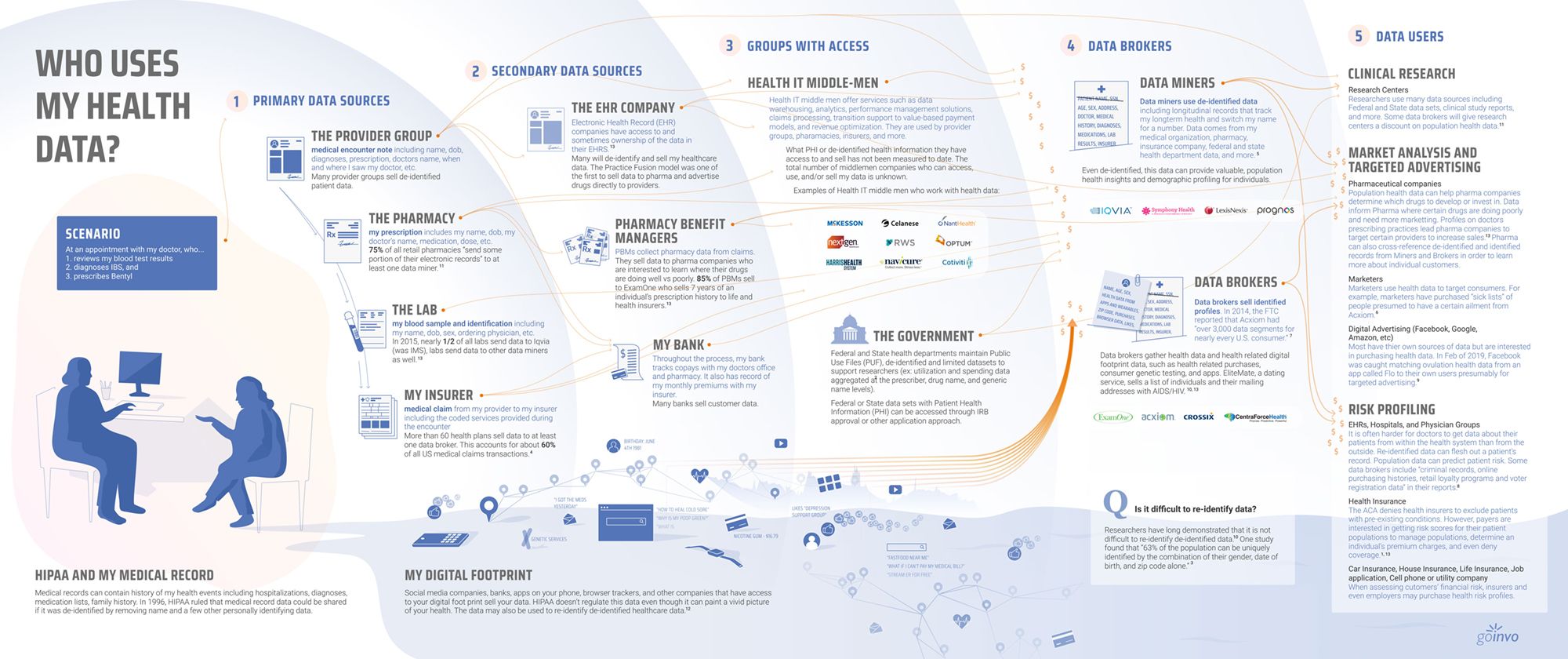
    https://www.goinvo.com/vision/who-uses-my-health-data/

    Do you know how many patients I have had that have gone home to try and commit suicide because healthcare TRAINED professionals offered up a fibromyalgia diagnosis in an ER for their chronic pain-related issues, and told them that this condition was not really able to easily be treated? I can tell you it is more than 1, which is already 1 too many. The last thing I want, is some AI delivered “depression magazine” or other non – provider approved intervention, to be given to someone who already feels isolated and alone, based on AI technology by some tech developer, who developed some robot algorithm, who can profit from patients and their healthcare data, using non-medical approved intervention, but using anything that, me as the clinician, even remotely appears to come from me — when I am the one with the license, the malpractice, and everything to lose. I also don’t want to lose a patient’s life to an intervention that may be highly inappropriate for them because of said AI robot that is brought to you by tech giant A or corporation G or social media platform F applying any population-based medicine to an individual with individual health needs that were not considered.

    I will also point out that “evidenced-based” interventions even at their best are sometimes only effective for 60% and can still be “statistically significant”. Many drug treatments with FDA approval only ride at the 30% effectiveness or less, as indicated by the STAR*D studies and other such literature reviews and significant healthcare studies. Does that mean every clinician only meets a 30% efficacy with the patient? No, we don’t, why, because we factor in individual needs when considering this literature. But, if you only apply the evidenced-based literature, What about the other 40% or 70%? Are they just going to be screwed, or forced to have some side effect? Or worse, end up dead from some AI robot intervention that didn’t consider the individual in front of them?

    There are many ways to arrive at the statistical significance and it is not always by helping the “majority”. I was exceptionally worried about individuals who are not clinicians starting to control these applications, with absolutely NO MEDICAL background. And while you may legally be protected as TECH GIANT xyz legal corporation agreements, by offering something a patient signs, my job as a clinician is to advocate on behalf of the patient to ensure that optimal outcomes are achieved. By implementing technology, based on AI with a signature, tech developers may feel that it is justified, but in my opinion, the patient needs to be working with their doctors/nurses/other healthcare professionals that work with them directly when it comes to offering any such “targeted” ads, apps, clickbait or anything else when it concerns health data.

    I have discussed how HEALTHCARE INSURANCE COMPANY nurses…read a file, look at documents, but they don’t have any relationship with the patient and this can be just as problematic. INSURANCE GIANTS have also started to “target interventions…and mind you, at least those are evidence-based” but they are still failing and costing the system by blanket targeting these interventions that are not relevant to many patients. Their “cost savings” measures that are applied in psychiatry, I can tell you, for a start, are some of the most ridiculous and expensive I have ever seen. If they were truly following “evidence-based practice” to perfection, we would not have a single readmission hospitalization within 30 days paid for by any insurance company where a patient with schizophrenia wasn’t placed on an injectable dopamine receptor blocking agent (formerly known as an antipsychotic). The literature time and time again support they are the most cost-effective and stabilizing treatment to date in schizophrenia, yet this is not what is applied in the U.S. Only a fraction of patients are placed on injectable medications even though health practitioners in psych/mental health are hammered over the head with how these should be first-line for psychosis. But, half of the insurance companies have applied “cost savings measures” that make it impossible to get a patient a “clean injectable” that isn’t straight out of the 1960s treatment book because they look at “cost” first but didn’t calculate all the expenses on the back end associated with metabolic syndrome, endocrine dysfunction (which by the way exacerbates psychosis) and if you give that risperidone or Haloperidol deconate, you may be shooting yourself in the foot to stop those hallucinations and causing 16 other inappropriate hospitalizations for obesity-related complications, hirsutism, prolactinomas etc. Test after test will be run all because to “save money” a clinician was forced to offer haloperidol deconate over say an aripiprazole injectable. To which I get to write joyous and long letters (sarcasm) just like this to said insurance provider, to appeal to a non-clinician on a computer prompter of why my patient should have a treatment which most assuredly in the long term would cost the least amount to society. Which is a giant waste of everyone’s time, and if I am lucky will get said intervention approved before they are in the hospital AGAIN because I was too busy appealing what evidence had already supported as the most efficacious treatment, plus already known to have less long term risks than the other medications I am forced to consider that NEVER take individual concerns of my patient that I have treated usually for YEARS into consideration. Plus, let’s just go ahead and look at the hospital systems themselves. After all most of them are owned by an MBA. Basically you have another entity that only stands to profit off the patient being sick. So our poor patients with schizophrenia, even when FREE INJECTABLES from the pharmaceutical companies are offered to them just like any other clinician are never used and gather dust on the shelves because the hospital system touts A) that they don’t believe in pharmaceutical company relationships – convenient … B) They make money off EVERY ADMISSION even if it is 2 days after discharge C) they make money of the generic pill that their pharmacy obtains and D) They make money when the nurse, the care manager, the clinical social worker, the community support worker, the therapist, and the hospital affiliated clinicians see this patient for having to keep said sick patient from “going inpatient” and keeping them on the chronic outpatient program. Not only that all of these facilities are given extra government funds to help “keep this patient well” by being a “community health center” because of how “expensive and costly they are”. When they are 100% contributing to the expense by not giving injectables, giving old drugs with adverse effects that their hospital pharmacy makes money on, and by underpaying yours truly, the nurses and one to one staff they are employing.
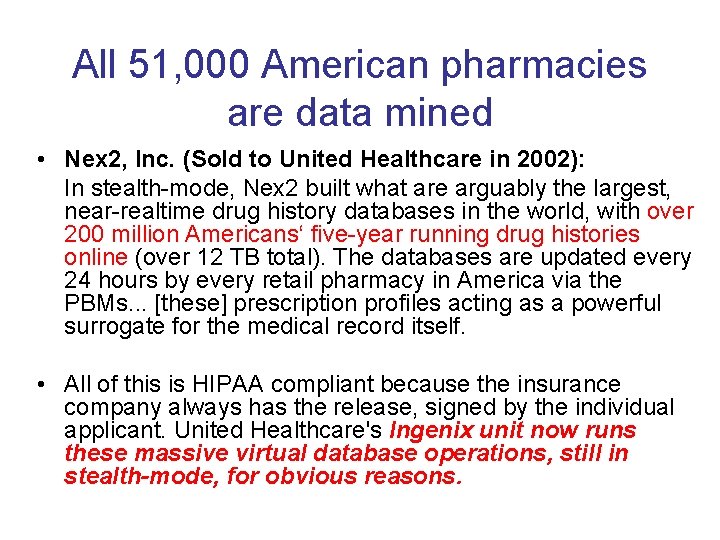
    https://slidetodoc.com/cambridge-university-electronic-health-records-which-is-worse/

    Another example of insurance trying to utilize their AI similarly, who I can tell you has been tracking data in healthcare longer than a general non-clinical AI developer TECH COMPANIES, and has clinicians on staff as medical directors; I have a patient that received for example a “screening kit” for colon cancer from A VERY LARGE INSURER, less than one month after she had a full colonoscopy.” And while I, the clinician, in this case, would have still encouraged the patient to still do the kit because a biopsy may not have been completed, or something could have been missed on that exam…this patient was quite upset that she was being “harassed by a nurse she didn’t know, about a kit that didn’t make sense to her”, and “her doctor” (meaning me the APRN treating her) “was not consulted”, and then furthermore the INSURANCE COMPANY CHRONIC CARE NURSE couldn’t explain why this scan was important and necessary. All of which are GIANT and important factors when delivering QUALITY CARE. (As a reminder the United States has some of the most expensive and the worst health outcomes for first world nations). For those of you I have taught to research this…don’t compare on the zebra diagnoses. It is silly to compare the U.S. on autoimmune to Japan when there are more cases of autoimmune in the U.S. You need to try to compare oranges to oranges. So one of those instances is maternal-fetal outcomes. Women are given birth to babies EVERYWHERE. IT is routine. United States outcomes, mind you where the majority of us are cared for in the HOSPITAL, are the HORRIFYING! Here is a nice little synopsis: https://www.commonwealthfund.org/publications/issue-briefs/2020/nov/maternal-mortality-maternity-care-us-compared-10-countries

    Back to our client with the poop test. This client had already told the nurse to screw off, that she (the nurse) knew nothing about her (which was true) outside of the “health collected data supplied by the insurance company, and diagnoses on her chart”. This nurse didn’t confer with me, this was a “blanket evidence-based approach without any thought”. Now, I’m not going to lie, I have a little bit of stronger invested interest in this, as I supplied said insurance company some strong evidence for how to do a chronic care management program.

    Evidence-based medicine is not blanket applying treatments because some study, even if it is a Cochrane literature review, says that there is statistical significance in offering an intervention; (although it is frequently misconstrued as such especially when someone stands to profit) — it is understanding the evidence as presented and then requires someone with some medical knowledge to interpret whether that “rule” or that “evidence” is in the best interest of the individual in front of them (unless said data clearly shows that 100% of people given the treatment improve, offering it as a blanket treatment will end up costing on the back end)…which last I checked still took a healthcare degree and had a direct working relationship with the patient. If you just apply even one singular evidence-based medicine intervention to the population, you are still only treating health at the population level and not the individual level. It is costly in lives and money. A clinician is trained to be considering both the population and the individual, and weighing those options before selecting what would be the best interventions for a patient is 100% still necessary even with a robot offering up CLINICAL DECISIONS.

    There is NO WAY that the AI currently being developed in healthcare is ready to pull out the necessary data in order to be able to then interpret and analyze from multiple selections of the best interventions for a client. I will give you another example. In medicine, a beta-blocker may not be first-line for a patient with HTN. In fact the current hypertension guidelines, it is not. But a smart clinician may be able to see that a beta-blocker would, by all means, be the best treatment for someone who has mitral valve regurgitation, panic attacks with social anxiety, hypertension, and tachycardia. This would be a MUCH BETTER first-line agent in all likelihood for that patient (over diuretic + our ACE/ARB) pending there aren’t other factors like asthma which would then require a knowledge that perhaps nebivolol in the UK is used in congestive heart failure (CHF) and has evidence to support that it doesn’t exacerbate pulmonary related symptoms. OR that perhaps they may need to look at alternate treatment. Yes, this is a medication, but other offerings that seem even as “benign” as a magazine can have disastrous outcomes for a patient. In addition, a patient may refuse medical care, but they are NOT the most informed when it comes to knowing if the interventions being targeted at them are going to be helpful or harmful for their condition. I tell my patients ALL THE TIME not to beat themselves up for not knowing something was good or not for their health. They didn’t go to school for the inordinate and amount of time that I did with record second mortgage creating debt that I am in to become a healthcare practitioner. Patients choose FAST FOOD every day, and in nursing, I like to consider that to be a “SIGNIFICANT KNOWLEDGE DEFICIT” because where people may have learned that “FAST FOOD is bad for them”…do they know why? I mean with a strong, INFORMED, and significant understanding of what that is doing to their body and in relation to their personal illnesses”? The answer is No. (For those that might still be wondering). Patients generally do not know why fast food is bad for them and their personal health condition. So these piddly “technology consents” that the business technology giant powers-that-be, that make all the money, have slapped together to cover their butts, are by no means a protective measure for patients and in NO WAY an INFORMED CONSENT MEASURE.

    I have over and over advocated how technology can be a great asset in healthcare when applied appropriately. But if any technology entity is applying, offering treatments and interventions, magazines, or other literature without a directed healthcare professional approving these products, that in my opinion is 100% practicing medicine without a medical degree — or RN even”. It is in no way shape or form appropriate to target any sort of offering to a patient whether it even be an unrelated health magazine. If that data is obtained from a medical record or informational system that comes from their health record, or even clicks based on a clinical encounter, the patient needs to be protected from their data being exploited. HECK! I’m A PATIENT TOO AND I WANT TO BE PROTECTED!

    HEY AMAZON, I am talking to you, because I’m here trying to REVOLUTIONIZE healthcare over here for the better, and if you want to avoid “The Social Dilemma 2.0”, BEZOS, CALL ME–let’s make this happen the right way! There is a way to do this — without exploiting humans! 😉

    I want to ensure that my patients are safe, that they are being offered valuable healthcare interventions. If it has ANYTHING to do with their health-related clicks. Or even more sensitively based off a PHQ-9 score, or even more sensitive a diagnosis or one step farther, someone’s GENETICS etc., then you cannot cut me, the clinician out of things when I have been here, on the ground with the patient for ten years and know them sometimes better than my own family (from being overworked by this system called healthcare as we know it!).

    I just want to ensure that any “targeted ads, AI, or other technology being recommended to my patients is appropriate” and would not cause further damage and worsening outcomes to their health.

    I also know that as a clinician, for most of these technologies, I am significantly overpaying you to utilize said technology in my practice. Then you are turning around and making a second profit on now targeting them like you have some kind of special healthcare knowledge because I introduced you into my practice!!! Then when your little tech waiver suggests that I am possibly making a profit from the technology or the magazines or whatever other clickbait you are providing so you can slip in there that you may be profiting too…HEY TECH PEOPLE, I’M TALKING TO YOU! I CAN’T GET PAID THAT WAY ding dongs (actually I know you know this which is why it isn’t mentioned in my BAA to you that you are going to do this to my patients)…because the rest of the world knows ALL YOU MBAs tied my hands YEARS AGO. I can’t make a profit of their health or their health data because of Anti-kick back statutes. So stop telling my patients that you are “paying me” or that I might be getting any sort of “reimbursement” for these targeted CLICKBAIT bogus interventions or for any sort of intervention that is being offered to my patient. The data they are clicking when checking in with me for telemedicine, or into their medical portal, or in any other medical app I am utilizing, should in no way shape, or form be used to offer “click ads for antidepressants, or click ads for a medical device, or click ads for an app” without express approval from the provider who is actually THE TREATING PROVIDER. But I know that is why you didn’t tell me in my BAA because you all knew that I will NEVER sign some blanket waiver for technology whether an APP or an EHR, to just offer things carte blanche to a single one of my patients without strong evidence that it is in the best interest of my patient.
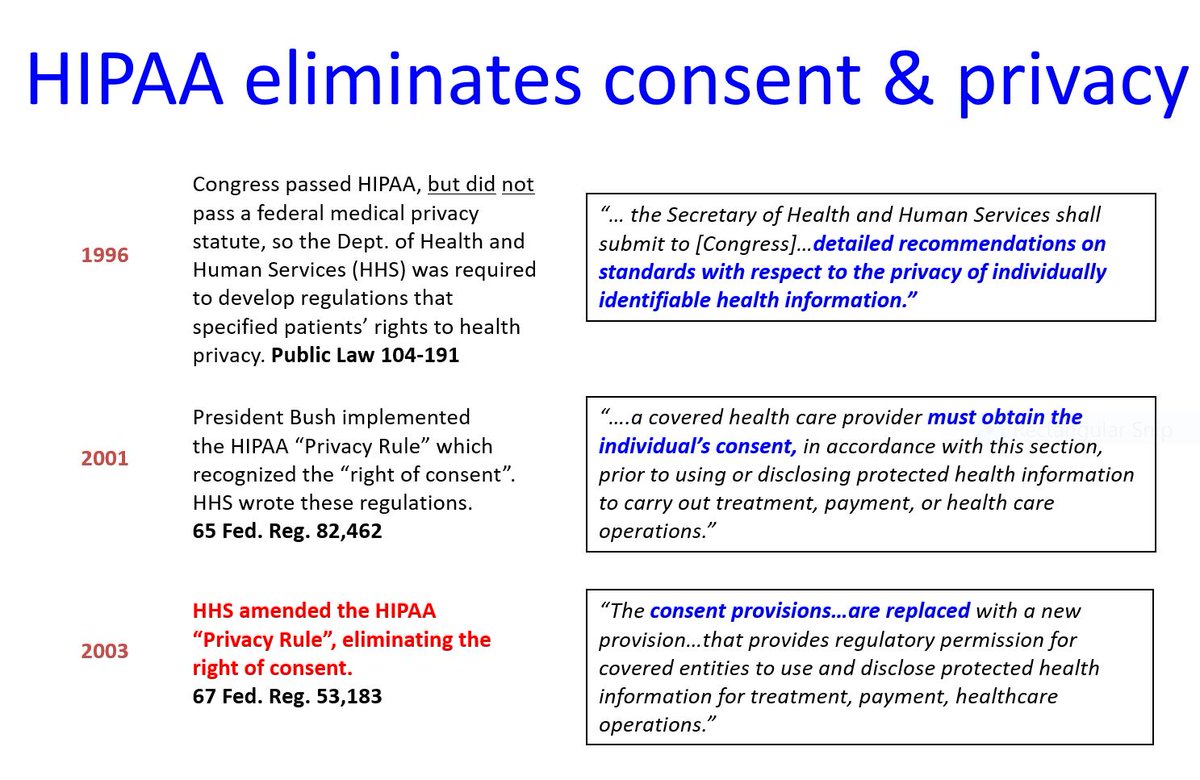
    So US Government, so FDA, so MEDICARE, and OIG, the ball is in your court! Because the tech community has started this game. It is on you to protect the patient now because you stripped my power a long time ago as a provider. Are you going to hold them to the same ridiculous standards as I am? Are they going to have to pay thousands for each of their providers in CEUs, are they going to have 200,000 in debt for 10 years of education, are they going to have to pay for malpractice, are they going to be liable for all the kickbacks they receive for offering Apps to patients by their PHI? Or are these pretty little technology waivers enough to absolve them of any risk whatsoever to offer a product to a patient based on their medical communication to me, the provider, overworked by this CORPORATE PRACTICE of MEDICINE because they got someone to sign a document that says now their data is no longer “HEALTHCARE data” and snuck that in the fine print? Are they going to be held accountable for not supplying true medical informed consent with all the training that entails? Please, let me know because if this is the future of healthcare as we know it, because if it is…. I’m out! The exploitation was bad enough before TECH companies “mining” our “PHI” that is no longer “PHI because we signed saying it wasn’t”!

    So TECH GIANTS, as a customer who has been forced to paying exorbitant prices for years because it was “healthcare technology”, and on behalf of my clients; I want you all to be held to my standards to offer “HEALTHCARE interventions”. You with your MBA, running health care, you who hijacked the hospitals years ago, you who took over with the insurance companies, I do not want YOUR BUSINESS DEGREE MBA from an online community college to target my patients based on any HEALTHCARE data clicks, uploads, or shares. I DO NOT WANT, your non scientifically proven apps, treatments, or magazines offered to my PATIENTS (my patients who are living breathing humans with families, and parents, and siblings!). My patients and every single one of US is a PATIENT at some point! You are in NO WAY SHAPE, OR FORM QUALIFIED to make any decision of what to offer my client in your clickbait! You should not be allowed to charge me exorbitant prices and then turn around and gouge my patients on your click ads! While I, the clinician, have to pay for all the risks. I have to pay for cyber protection of their data. I the covered entity have to pay for coverage for your healthcare data breaches! And the government already took away my ability to make money on any intervention offered to a patient years ago, but why are you allowed, tech person with MBA allowed to make all the money of their data and you know nothing about them?

    If I am not directly approving the interventions themselves, plus NOT being provided all this data you have gathered and “mined”, that really should have been given to be plus a steak dinner and a TESLA because of your overpriced technology listed as “Healthcare Technology”; I do not in any way shape or form as the clinician and as a nurse as well; approve of any intervention being applied to my patient without them being fully informed BY YOU THE PROFITER unless you are using a full MEDICAL INFORMED CONSENT processes, of the interventions (that is what your clickbait, apps, target at health really are) without them being fully aware of all the risks vs. benefits of any said intervention. This includes all your apps, magazines, technologies, link to other services, links to treatment facilities, links to educational organizations, or any other such treatment or intervention that you all may view as “marketing”. In reality, once has been offered based on your “mined” health information and the PHI you have collected from my practice, it ceases to be marketing and is now 100% is “interventional”. If I give a scrap of paper with directions on it, I as a healthcare professional can be held accountable. Well, you know what tech companies, you can’t just take my patient’s health data, have them sign a little slip of paper that says they allow you to offer interventions, and not be held to the same standard that I the clinician am, and expect people to be okay with that. If you want those profits, then pay for it with the blood, sweat tears, malpractice, board certifications, and everything else I did. Not just because you took an advertising and coding class online. Try and figure out how to make a profit with a healthcare professional license LEGALLY while not exploiting the people you serve.

    A nurse (RN) that identifies a patient at risk for breathing deficits and offers links to healthcare groups that can assist with breathing support is still supplying a “healthcare intervention” that is bound to their license. They can still be sued if the links they supplied resulted in worsening of the patient. But you TECH GIANT are allowed to do the same thing without a license, or sitting in the basement of your parents’ home and profit off me the clinician, AND my patient, where is the logic in that?


    Share this:

    • Share on X (Opens in new window) X
    • Share on Facebook (Opens in new window) Facebook
    • Share on LinkedIn (Opens in new window) LinkedIn
    • Share on Tumblr (Opens in new window) Tumblr
    • Share on Pinterest (Opens in new window) Pinterest
    • Print (Opens in new window) Print
    • Email a link to a friend (Opens in new window) Email
    Like Loading…
  • Welcome to Holon Inclusive Health System – What is a Holon?

    In 1967, Arthur Koestler introduced the theory of holarchy (The Ghost in the Machine) to discuss a model for how natural systems are organized. He coined the term “holon” for an entity that was whole in and of itself and also part of a greater whole; a whole-part. Koestler suggested that as individuals we are each a whole becoming part of a greater and more complex whole. In holarchy: An example would be: As letters make up words, and words make up paragraphs, and paragraphs make up pages, and pages make up books, so too are we organized psychologically, physically and socially in ever-increasing complexity.

    Interestingly, holarcy also proposes that at each level of complexity, which is more than the sum of the parts, something unique and powerful happens which becomes important to the development or environmental sustainability theory.  The simplest rule of holarchy is that if you take away holons of lesser complexity the more complex ones disappear. So in our example of books: No letters and there are no words, no words mean no sentences, and so on. Koestler’s concept of holarchy is open-ended, both in the macrocosmic as well as in the microcosmic dimensions. This implicates that if we take string theory to be legitimate, the holarchic system does not begin with strings or end with the multiverse; instead those are limits of the human mind in the two dimensions.

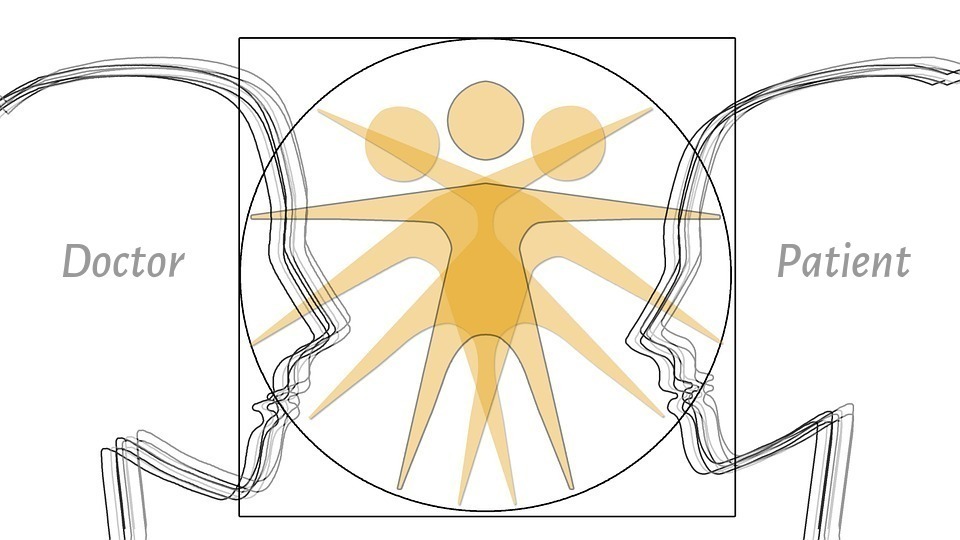
    As practitioners, patients we must also look at our patients through the lens of holarchy. Our patients are individual systems that are all parts of a greater and more complex whole. Each part of our patient (each organ or cell) is also a part of a greater whole. We must look at each part of our patient within the context of the greater wholes in order to achieve maximum wellness. If we do this, then we will be able to offer truly holistic healthcare and individualized services to our patients. We must look at all the layers that can be affecting our patients health and address them all simultaneously. This is what will lead to maximum wellness with our patients.

    Holon Theory drives the idea of holistic health. Which as a practitioner I believe in through and through.

    Dr. Alice Lee provides an excellent definition of holistic psychiatry on her website:

    “Holistic Psychiatry values each individual as a unified whole, consisting of mental, emotional, physical, spiritual, social, and environmental forces that simultaneously and equally affect health and well-being.  A holistic psychiatrist is trained in the use of conventional, nutritional/ functional/ orthomolecular medicine, and mind-body/energy medicine, to heal individuals at all levels of being, to restore a state of optimal mental and physical health, as naturally and efficiently as possible.”

    The Arizona Center for Integrative Medicine provides a great definition for “integrative medicine” on their website:

    Integrative Medicine (IM) is healing-oriented medicine that takes account of the whole person, including all aspects of lifestyle. It emphasizes the therapeutic relationship between practitioner and patient, is informed by evidence, and makes use of all appropriate therapies.

    “Defining Principles of Integrative Medicine:”

    1. Patient and practitioner are partners in the healing process.

    2. All factors that influence health, wellness, and disease are taken into consideration, including mind, spirit, and community, as well as the body.

    3. Appropriate use of both conventional and alternative methods facilitates the body’s innate healing response.

    4. Effective interventions that are natural and less invasive should be used whenever possible.

    5. Integrative medicine neither rejects conventional medicine nor accepts alternative therapies uncritically.

    6. Good medicine is based in good science. It is inquiry-driven and open to new paradigms.

    7. Alongside the concept of treatment, the broader concepts of health promotion and the prevention of illness are paramount.

    8. Practitioners of integrative medicine should exemplify its principles and commit themselves to self-exploration and self-development.

    Share this:

    • Share on X (Opens in new window) X
    • Share on Facebook (Opens in new window) Facebook
    • Share on LinkedIn (Opens in new window) LinkedIn
    • Share on Tumblr (Opens in new window) Tumblr
    • Share on Pinterest (Opens in new window) Pinterest
    • Print (Opens in new window) Print
    • Email a link to a friend (Opens in new window) Email
    Like Loading…
  • 8 easy techniques you can do at home to unblock your chakras

    This is your blog post. To really engage your site visitors we suggest you blog about subjects that are related to your site or business. Blogging is really great for SEO, so we recommend including keywords that relate to your services, products or industry within your posts. It’ll make it easier for people to find you on the web.

    Ready to delete this post and add your own? Go to Manage to open your Dashboard and click on the 3 dot icon ( ⠇), then click Delete Post. You can also head to Settings > Manage Blog and delete any post from there. Now you are ready to create a blog post of your own! Look for the Create New Post button to start crafting your own stunning blog content.

    #massage #chakras

    Share this:

    • Share on X (Opens in new window) X
    • Share on Facebook (Opens in new window) Facebook
    • Share on LinkedIn (Opens in new window) LinkedIn
    • Share on Tumblr (Opens in new window) Tumblr
    • Share on Pinterest (Opens in new window) Pinterest
    • Print (Opens in new window) Print
    • Email a link to a friend (Opens in new window) Email
    Like Loading…
1 2 3 … 7
Next Page

Proudly Powered by WordPress.com


Loading Comments...
 

    • Subscribe Subscribed
      • Home | Jessica Giddens DNP, BA, APRN, PMHNP-BC, RN-BC |
      • Already have a WordPress.com account? Log in now.
      • Home | Jessica Giddens DNP, BA, APRN, PMHNP-BC, RN-BC |
      • Subscribe Subscribed
      • Sign up
      • Log in
      • Report this content
      • View site in Reader
      • Manage subscriptions
      • Collapse this bar
    %d